
Cats stare at walls, corners, something just above your left shoulder. And no matter how many times it happens, there’s always that half-second of genuine unease – what does it see? Turns out that humanity has been mulling this over for approximately ten millennia.
Cats were not really domesticated in the classic sense. Around 7500 BCE, they entered human communities in the Near East, looked around, evaluated the situation, and remained on their own terms. Every cat owner reading this is nodding, because nothing about that has changed. And it’s precisely that quality, the radical self-possession, the sense that the cat is choosing to be here and could just as easily not be – that made them magnetically interesting to anyone dealing in mystery and the invisible.
Some people, curious about what’s literally written in their cat’s DNA, take a cat breed test, and sometimes the results feel almost eerily explanatory. A cat with strong wild lineage stalking shadows at 3 a.m. suddenly seems less random. Anyway, let us come back to the witches.
The Church’s Impact
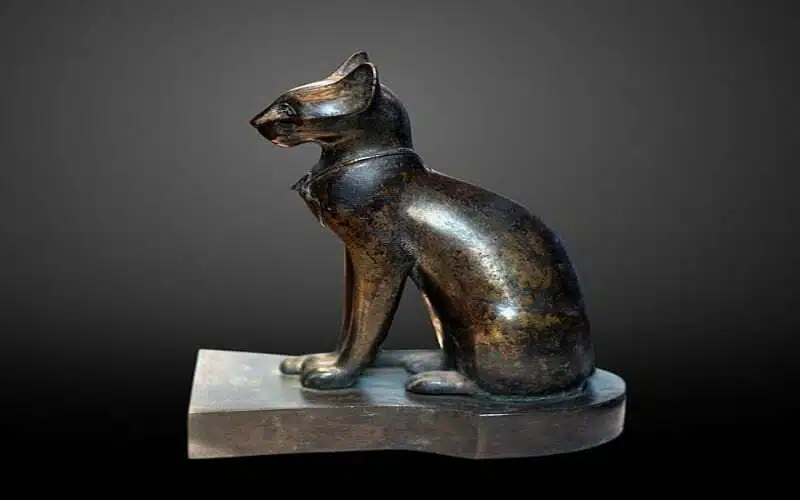
When it comes to cat worship, ancient Egypt gets the most attention. The cat-headed goddess of protection and fertility, Bastet, was so loved that killing a cat resulted in death.
Then came medieval Europe, and the pendulum swung strongly. In his 1233 edict Vox in Rama, Pope Gregory IX expressly identified black cats as devil’s tools. What followed was centuries of mass cat culling across the continent, and, predictably, an explosion in the rat population, and with rats, plague. The historical irony is almost too neat. People killed cats to protect themselves from evil energies, thus creating one of the darkest times in human history.
But what’s amazing about persecution is that it doesn’t remove meaning. It concentrates it. The more aggressively the church associated cats with witchcraft, the more that association crystallized into something almost mythological. By the height of the European witch trials in the 16th and 17th centuries, the cat-as-familiar had become so embedded in the cultural imagination that no amount of burning was going to dislodge it.
What Actually Is a Familiar?
In occult tradition, a familiar is a spirit that takes animal form and participates in magical work. Not beside it, but IN it. The distinction matters to practitioners.
Cats were deemed suitable receptacles for a few reasons that, even without any supernatural framework, stand up rather well:
- They’re crepuscular – most active at dawn and dusk, the liminal hours that have always carried symbolic weight in magical traditions worldwide;
- They perceive frequencies of sound and light that humans simply cannot, which across cultures has read as access to a layer of reality we’re shut out of;
- They’re simultaneously deeply bonded to their humans and radically independent – a psychological combination that mirrors the witch archetype almost perfectly.
Modern practitioners describe their cats gravitating toward altars, sitting at the edges of ritual circles, appearing the moment someone sits down to meditate. Skeptics will say cats just like routine and body heat. Then again, the two explanations aren’t mutually exclusive.
The Cat In Tarot
Slowly flip through a Rider-Waite deck, and the cats will collect. A black cat sits at the Queen of Wands’ feet. In tarot symbolism, that cat represents her connection with her shadow. She is strong because she is not scared of what the cat symbolizes.
Three Ways Cat Energy Reads in a Spread
Readers working with decks that carry strong feline imagery tend to interpret it through a consistent set of frames:
- Threshold energy: the cat as a figure sitting between what’s known and what isn’t, asking the querent what they’re avoiding looking at directly
- Shadow companion: the repressed self, the “too much” that was trained out of someone, asking to be acknowledged
The High Priestess carries no literal cat in most decks. And yet she is the cat. Intuitive, still, receptive, formidably unbothered. The archetype and the animal describe the same thing.
Feminine Energy Has Nothing to Do With Gender Here
Worth saying clearly: when practitioners talk about cat energy as “feminine”, they’re not talking about women. They’re talking about an archetypal principle – receptive, cyclical, interior, sovereign. What Jung called the anima. What the I Ching calls yin.
Hecate, Greek goddess of magic and crossroads – cats. Freya, Norse goddess of love and war – also cats, specifically pulling her chariot. Bast, obviously. These mythologies developed in complete isolation from each other. The recurrence isn’t coincidence; it’s pattern recognition across civilizations.
That pattern is very much alive. A Pew Research study put the number of self-identifying Wiccans and witches in the United States at roughly 1.5 million – a figure that has almost certainly grown since 2018. The resurgence of interest in witchcraft, lunar practice, shadow work, and goddess traditions has happened in almost perfect parallel with what might be the most cat-saturated cultural moment in human history. Whether that’s profound or simply hilarious is definitely up to the reader.
The cat, for its part, doesn’t care either way. It’s already moved on to staring at something in the corner.
