

Aren’t all poker versions the same? No, they are not. From a logical perspective, the general rules and so on are still the same. But different versions have their own unique characteristics that determine the pressure on players during the game, the decision-making process, and, of course, the ability to control one’s emotions.
It turns out that one specific version of poker has more to tell us about its influence on emotional regulation, and it’s not the most famous one, Texas Hold’em, which you may know even from movies.
What is so special about the Omaha variant compared to usual poker?
Omaha feels different because each player starts with four private cards instead of two. That single change makes the game far more complex. A hand can connect with the board in several ways at once. Players see more draws, more possible strong hands, and more reasons to stay involved in a pot.
The structure matters. Under poker omaha rules people learn, a player must use exactly two hole cards and three community cards to make a final hand. That creates a game where hand reading is more demanding and surface strength can be misleading. A hand that looks powerful may already be vulnerable. A board that seems safe can change fast on the next card.
This is what makes Omaha special compared with the usual version of poker. The game creates more live possibilities at every stage. That raises the emotional pressure because players are constantly balancing hope, caution, and uncertainty. There are more moments when someone feels heavily invested in a hand, even though the situation is still fluid.
The omaha rules in poker create a game that forces players to stay flexible.
Please, embed the link:
Emotional control matters more than patience alone
Patience alone is not enough. Players have to:
change their judgment quickly,
accept that a strong hand can still lose,
and avoid becoming too attached to one idea about the hand.
That is why Omaha is such a strong test of emotional control.
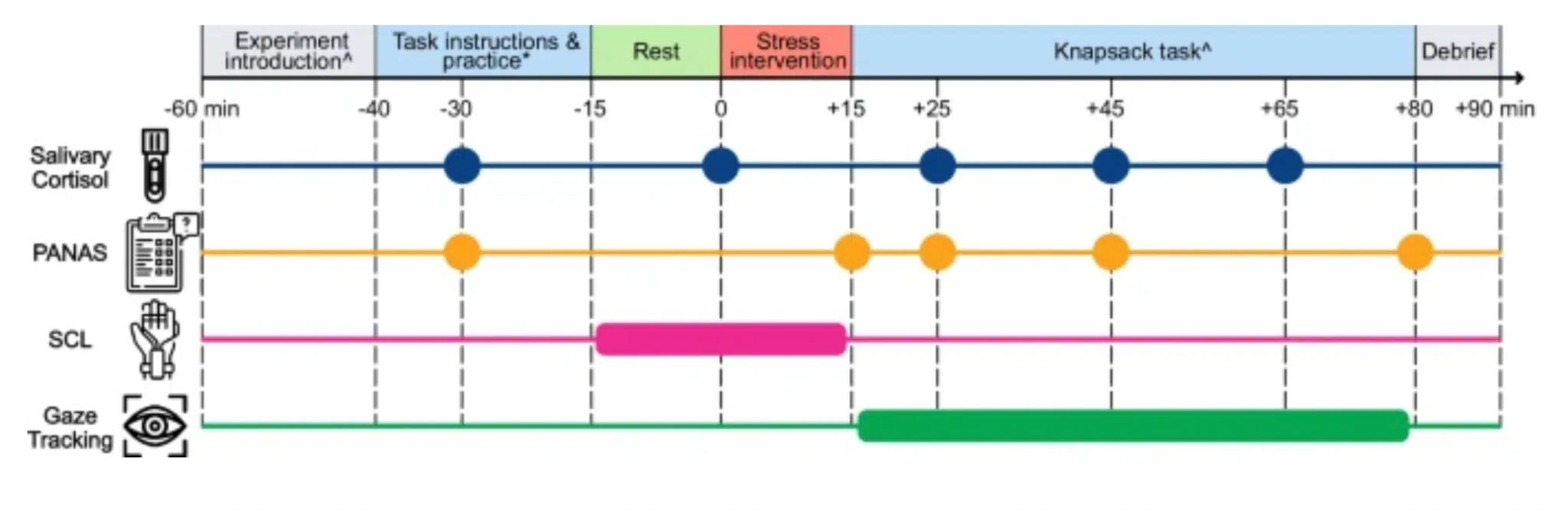
Here is how researchers measured stress step by step, using cortisol, mood, skin conductance, and gaze tracking before and after a stress intervention. We can conclude that emotional regulation in Omaha can be studied through clear markers of stress and attention, not just through player behavior after a win or loss.
Source: Here
Once a player understands these poker rules, the deeper challenge becomes clear. Omaha rewards people who can stay calm while many outcomes remain open. Its pressure comes from complexity, not from waiting. That makes it a stronger test of emotional regulation than the standard version of poker.
Why Omaha interests psychologists to understand human emotions
Omaha interests psychologists because it puts uncertainty, quick thinking, and emotional pressure in one game.
A player has to:
think about probabilities,
read how the board is changing,
and control their own reactions.
All of this happens at the same time. That makes Omaha useful for studying how emotions affect decisions.
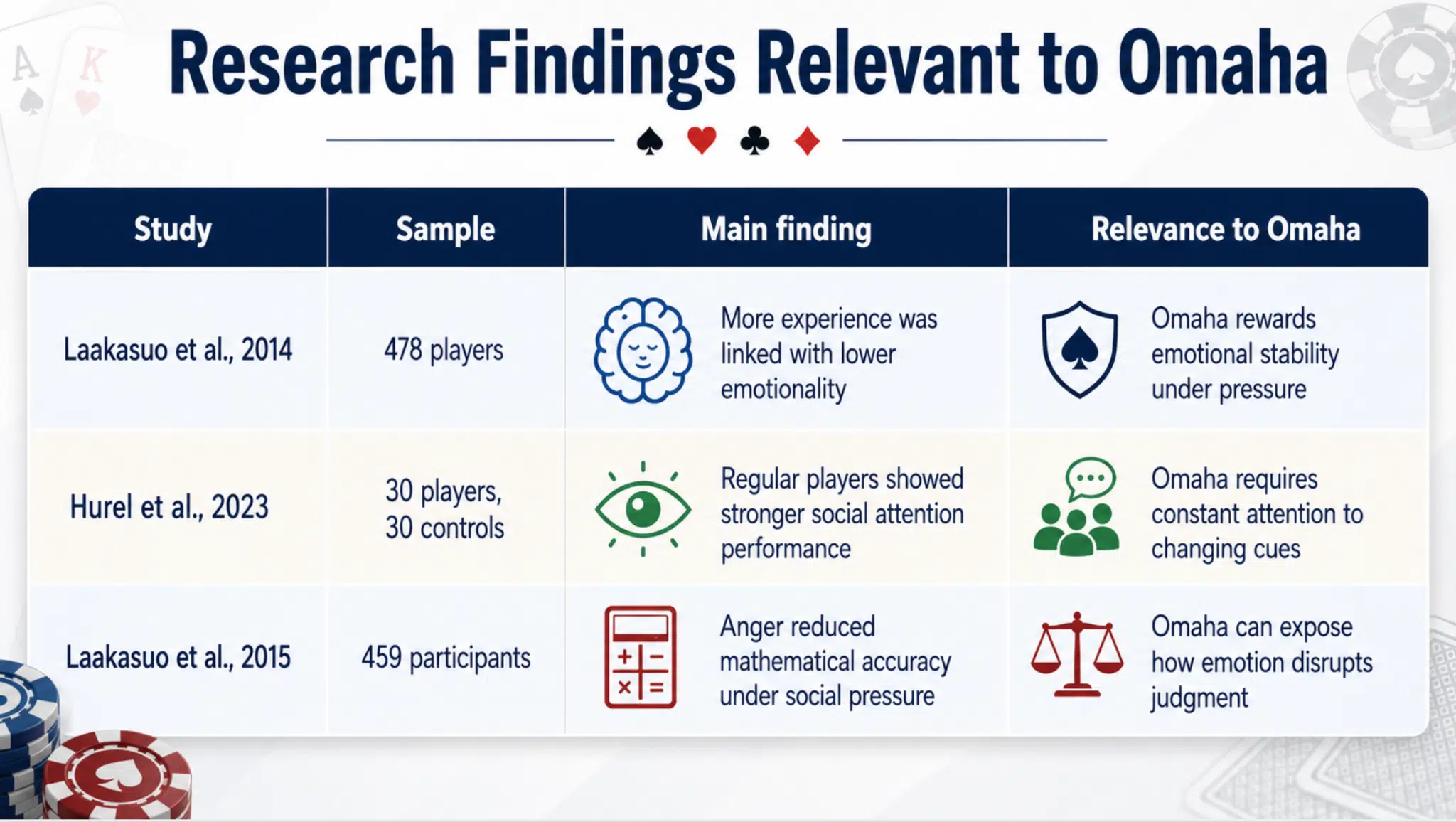
This table supports the article’s main point: Omaha tests emotional control more than patience. The game puts players in situations where they need attention, emotional stability, and clear thinking all at the same time. Experienced players tend to make clearer decisions, regular players are better at reading social cues, and anger can weaken judgment. That matches Omaha’s fast and high-variance style, where players must adjust quickly without letting emotion take over.
Original visual material, specifically created for this article.
Omaha sharpens these effects because the game creates more possible outcomes and more emotional swings within a short span. Players are often forced to process uncertainty while feeling invested in the result. That makes Omaha a useful setting for psychologists who want to understand how people think when emotion is active rather than quiet.
How Omaha tests emotional regulation and what it means
Omaha tests emotional regulation by forcing players to make good decisions after emotionally difficult outcomes. Strong hands lose. Big draws miss. Correct reasoning can still produce a painful result. The important question is what happens next.
A 2025 paper in Frontiers in Psychiatry described tilt this way: “The term tilt was first used by poker players to describe a state of emotional disruption leading to loss of control over behavior.” That definition fits Omaha especially well because the game produces many moments that can trigger that disruption.
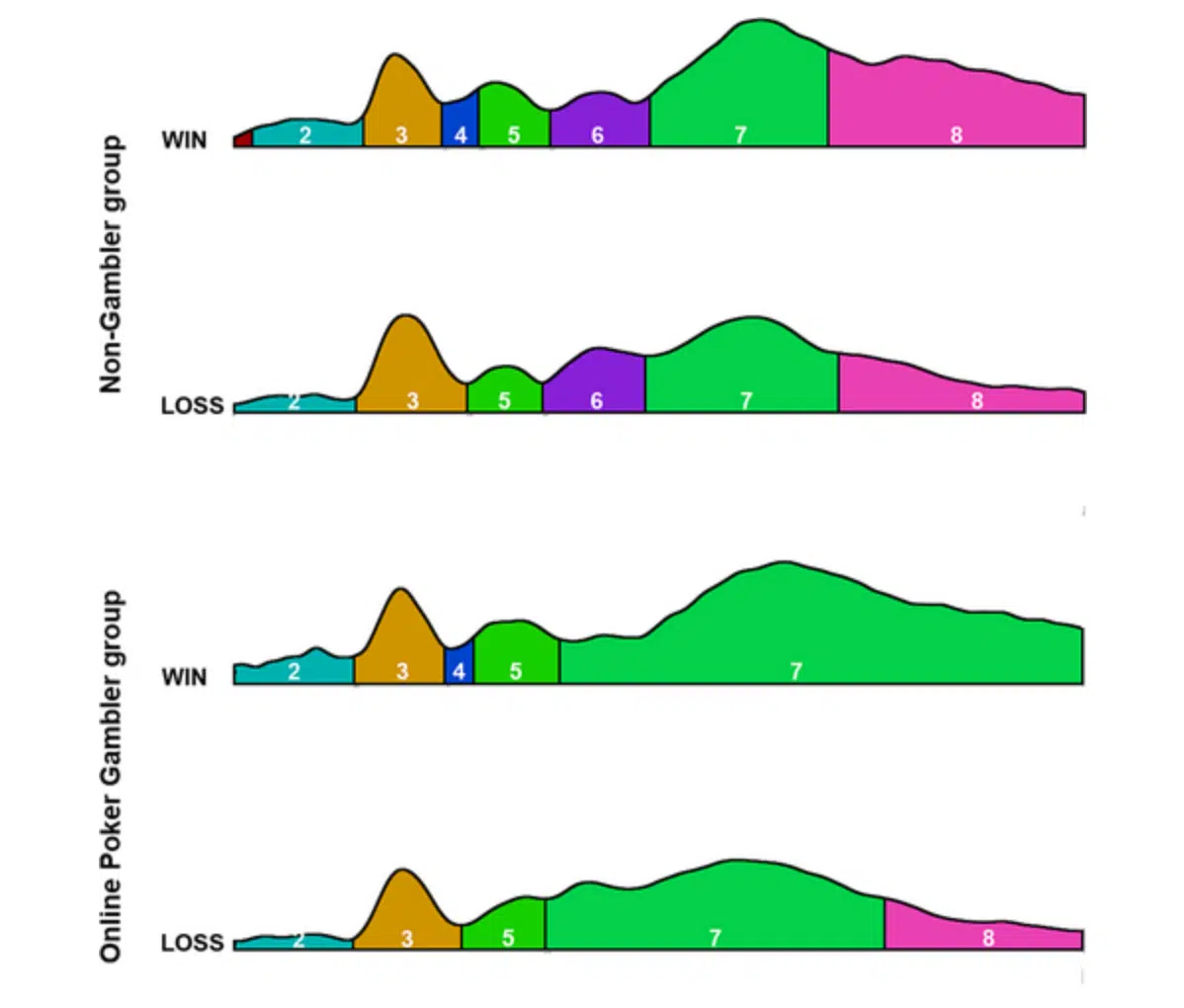
Results of segmentation after a win and a loss in the non-gambler and online poker gambler groups:
Studies suggest that online poker players respond to wins and losses with a more concentrated and stable decision pattern than non-gamblers, whose responses appear more spread across different outcome segments.
Source: Here
The real test comes after the tough outcome
The broader meaning is that Omaha reveals whether someone can return to clear thinking after stress, and stay mindful. It shows whether they can separate one result from the next decision. It also shows whether they can stay measured when complexity rises and emotion pushes them toward impulsive action.
That is why Omaha is a better test of emotional regulation than patience. Patience helps a player wait. Emotional regulation helps a player think well after pressure, excitement, and disappointment have already entered the game.
The strongest skill is staying clear under stress
Poker shows that good decision-making depends on emotional steadiness. The strongest skill is not waiting longer. It is staying clear when the game becomes emotionally intense.
